Product Strategy & Venture Building | The Complete Guide to Building Successful Digital Ventures
- By, Admin
- 30 Jul, 2026
Many digital products fail not because the technology is weak, but because the strategy behind the product is unclear. A successful digital venture needs a validated market opportunity, a practical business model, a clear customer promise, a focused product roadmap, and a realistic plan for launch and growth. This is where product strategy and venture building become essential.
What Is Product Strategy?
Product strategy is the structured direction that explains why a product should exist, who it is designed for, what problem it solves, how it creates value, and how it will compete in the market. It connects customer needs with business goals and gives every product decision a clear purpose.
A strong product strategy usually includes market research, target-customer definition, value proposition, product positioning, competitive differentiation, pricing direction, product priorities, and measurable business objectives. Without this foundation, teams often build features based on assumptions rather than evidence.
The purpose of product strategy is not to predict every future decision. Its purpose is to create enough clarity to help teams prioritize the right opportunities, avoid unnecessary development, and align technology with commercial goals.
What Is Venture Building?
Venture building is a broader model that combines strategy, product design, technology, branding, operations, marketing, and growth into one coordinated process. It goes beyond advising a startup or delivering software. The objective is to create a complete digital business that can launch, attract customers, operate efficiently, and continue evolving.
A venture builder studies opportunities, validates ideas, designs business models, plans the customer experience, builds the product, prepares the go-to-market strategy, and supports ongoing growth. This approach treats the product as part of a wider business system rather than as an isolated application.
At Pillars, venture building is closely aligned with our model of building, owning, and operating digital ventures. We bring together the strategic, technical, creative, and operational capabilities required to move from idea to sustainable market presence.
Technology should support a validated business opportunity. It should not become the starting point for a product that has no clear market, customer, commercial direction, or reason to exist.
Why Strategy Matters Before Development
Businesses sometimes move into development too early because building software feels like visible progress. However, development without validation can create expensive products that customers do not understand, need, or value.
Common causes of failure include unclear positioning, weak customer research, too many unnecessary features, unsuitable pricing, poor market timing, and the absence of a structured launch plan. Product strategy reduces these risks by answering critical questions before major development commitments are made.
The right strategy also improves internal alignment. Product teams, designers, developers, marketers, executives, and investors can work toward the same outcome when the target customer, product promise, and commercial model are clearly defined.
The Product Strategy and Venture-Building Framework
A structured framework helps transform uncertainty into clear decisions. Although every venture is different, most successful digital products move through a similar sequence of research, validation, planning, development, launch, and improvement.
Market Research
Study industry trends, customer expectations, market size, competitive pressure, and unmet needs. Research helps determine whether the opportunity is large enough and relevant enough to justify investment.
Opportunity Validation
Test demand through interviews, concept testing, prototypes, landing pages, and early market feedback. Validation reduces risk before major resources are committed.
Business Model Design
Define customer segments, value proposition, revenue model, pricing, key costs, delivery channels, and operational requirements.
Product Positioning
Clarify who the product is for, what problem it solves, how it is different, and why customers should choose it over existing alternatives.
Product Roadmap
Prioritize the minimum viable product, future releases, dependencies, development stages, operational needs, and growth milestones.
Go-to-Market Strategy
Plan marketing, sales, launch channels, customer acquisition, onboarding, support, retention, and the metrics used to evaluate market response.
Venture Building vs. Traditional Software Development
Traditional software development usually focuses on delivering a defined technical scope. Venture building begins earlier and continues longer. It asks whether the product should be built, how it will create value, how it will generate revenue, and how it will grow after launch.
| Area | Traditional Development | Venture Building |
|---|---|---|
| Starting Point | Technical requirements | Market opportunity and customer need |
| Primary Focus | Building features | Building a scalable business |
| Business Model | Often outside scope | Core part of the process |
| Launch Support | Limited | Go-to-market and customer acquisition |
| After Launch | Maintenance | Optimization, growth, and expansion |
Common Product Strategy Mistakes
One of the most common mistakes is developing too many features before validating the core problem. This increases cost, delays launch, and makes it harder to understand what customers actually value.
Another frequent mistake is targeting an audience that is too broad. A product designed for everyone often communicates weakly to everyone. Strong positioning usually starts with a clearly defined customer group and a specific problem.
Businesses may also copy competitors without creating a meaningful difference, set pricing without customer research, launch without an acquisition plan, or treat the first product version as a finished solution rather than a learning stage.
How Pillars Approaches Venture Building
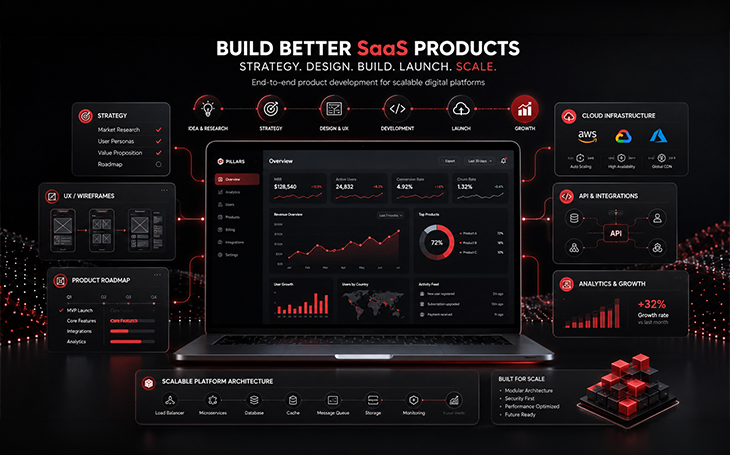
Pillars brings together product strategy, AI and SaaS development, web and mobile platforms, business systems, branding, marketing, cloud infrastructure, integrations, and continuous operations. This allows us to evaluate a venture as a complete business rather than as an isolated technology project.
We begin with research and validation, then define the product direction, business model, customer journey, roadmap, and launch priorities. Development follows a structured strategy, while branding, content, operations, and growth planning are prepared in parallel.
This integrated approach reduces gaps between strategy and execution. Product, technology, marketing, and operations are planned as connected parts of the same venture rather than as separate activities managed at different times.
After launch, the venture continues to evolve through customer feedback, market performance, operational data, and new growth opportunities. This creates stronger alignment between product decisions and commercial objectives.
Strategy, Technology, Operations, and Growth in One Connected Process
Frequently Asked Questions
Its purpose is to align customer needs, business goals, product priorities, and market positioning before development decisions are made.
Venture building is the process of creating and growing a complete digital business through strategy, product development, branding, operations, and market execution.
Validation reduces risk by testing whether customers understand the problem, value the proposed solution, and are willing to adopt or pay for it.
A minimum viable product is the first focused version of a product that delivers enough value to test key assumptions with real users.
A roadmap should be created after the customer problem, product direction, and business priorities are clear enough to guide development.
Yes. Established companies can use venture building to create new products, enter new markets, modernize services, or develop new revenue streams.
No. Successful venture building continues through customer feedback, performance analysis, operational improvement, and product growth.
Conclusion
Successful digital ventures do not begin with coding. They begin with a clear understanding of the customer, the market, the business model, and the value the product must create. Product strategy provides this direction, while venture building connects that strategy with execution, launch, operations, and long-term growth.
For businesses seeking to create scalable digital products, the strongest approach is to combine market insight, disciplined validation, focused development, and continuous improvement. This is how ideas become ventures that can compete, grow, and create lasting value.